Thursday, July 16, 2026
Visitation
4 p.m. – 8 p.m. CT
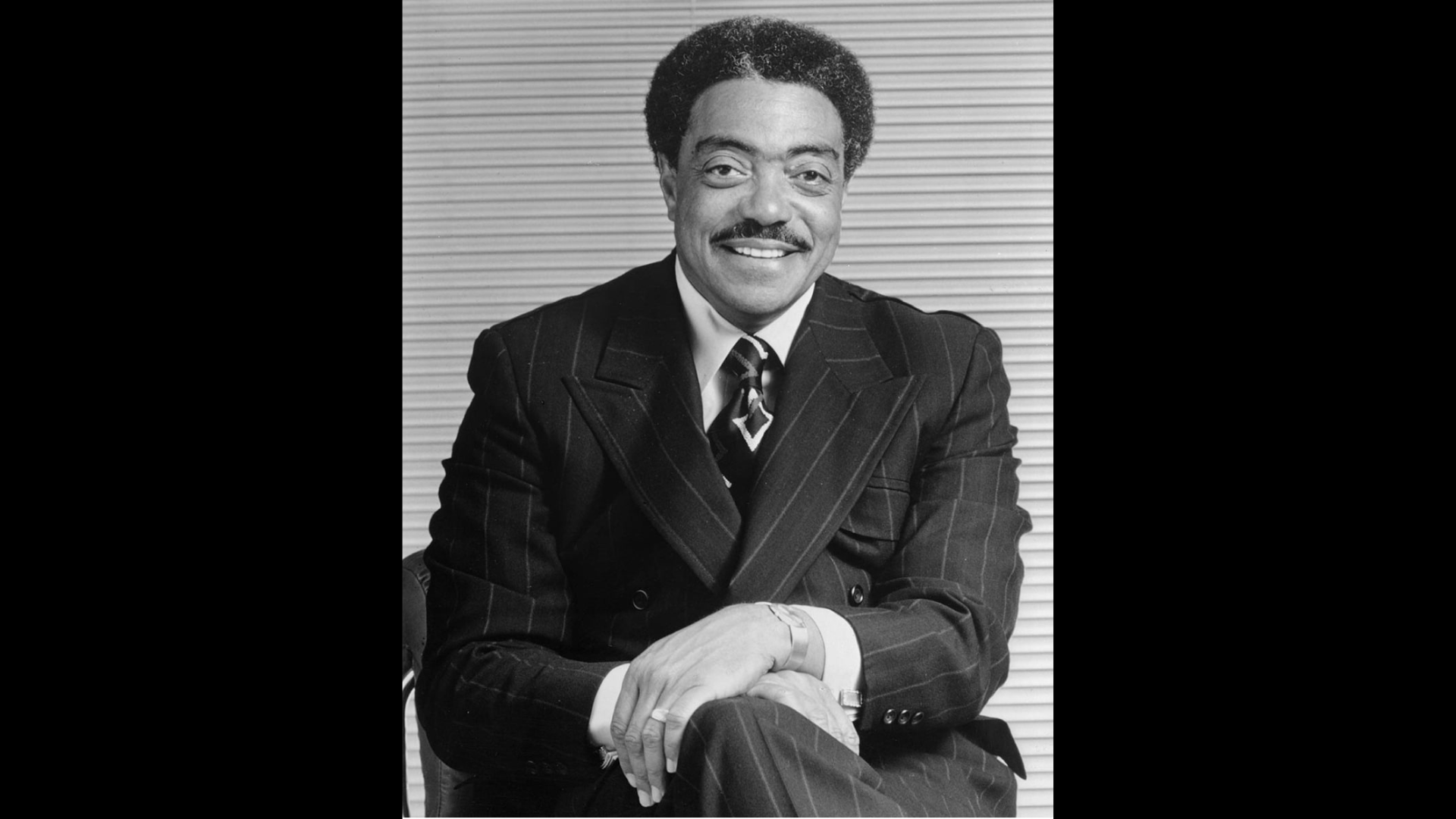
Celebration of Life for
June 16, 1927 — July 6, 2026
Trailblazing entrepreneur, founder of Johnson Products Company, and lifelong philanthropist.
In Loving Memory
George Ellis Johnson, Sr., 99, trailblazing entrepreneur and founder of the Johnson Products Company, the first Black-owned company to be publicly traded on a major U.S. stock exchange, passed away peacefully at home on July 6, 2026, in Chicago, Illinois.
Founded in 1954, Johnson Products Company (JPC) manufactured the iconic Ultra Sheen and Afro Sheen haircare brands, financially sponsored Soul Train so it reached national audiences, and was once the largest Black-owned manufacturing company in the world. In 1964, Johnson cofounded Independence Bank — the first Black-owned financial institution to operate in Chicago since the Great Depression — becoming both the chairman of the bank and chairman of its executive committee. The Wall Street Journal included Johnson in its special report “10 Who Made a Difference: The minds that transformed entrepreneurship in the 20th century.”
Born on June 16, 1927, to Priscilla Dean Johnson and Charles David Johnson, George E. Johnson’s life began on a sharecropping plantation in Richton, Mississippi. Two years later, Priscilla Johnson fled the physical and economic violence of the Cotton South, joining the Great Migration north. She brought George and his brothers, John and Robert, to Chicago, where her siblings had moved, arriving months before the onset of the Great Depression. Johnson called his mother “the most courageous person I’ve ever known.” Johnson’s father wrote his sons and sent them money, eventually remarrying and relocating to Joliet. Both parents were deeply spiritual and Johnson always carried an abiding sense of God’s presence.
To help his mother make ends meet, Johnson started his first business, with John, at age 6, selling aluminum scraps to the “junk man” in the alley, followed by a paper route and other jobs. In 1944, Johnson left Wendell Phillips High School to work at Fuller Products, the largest Black-owned business in the United States, a decision he would describe as leaving “one educational institution to join another.” Each morning, Johnson absorbed founder S. B. Fuller’s inspirational messages: “God does not intend for you to be poor,” “match your gifts to a need in the world,” and “take what you have and make what you want.” Fuller ran his business by following the spiritual precept of the Golden Rule — treating people as he would want them to treat him. The principle resonated within Johnson so deeply he believed it was something he must do. After starting in sales, Johnson worked in the lab as a production chemist, compounding products. There, he met chemist Dr. Herbert Martini, who, a decade later, would help Johnson create his first product, Ultra Wave, a hair straightener that helped Black men be seen as fully human during an era when they often were not.
Originally unable to obtain $250 for a business loan, Johnson secured the funds from a different branch of the same bank, instead telling the manager he wanted the loan so he could take his wife on vacation. He then used the money to start his venture, formally founding Johnson Products Company on June 15, 1954. His high-school sweetheart, the former Joan Henderson, whom he’d married in 1950, rolled up her sleeves to help get the firm off the ground and eventually ran the accounting department. Joan was also mother to the couple’s four children: Eric, John (Johnny), George Jr. (Petey), and Joan Marie (Joanie).
Johnson built JPC by following the Golden Rule, believing that focusing on helping barbers and beauticians rather than chasing profits would build the company. Always attentive to product safety and wanting to distinguish JPC from fly-by-night firms, Johnson insisted on training barbers, hairdressers, and distributors before allowing them to purchase his innovations. Ultra Wave’s success led to the creation of Ultra Sheen relaxer, the first product to permanently straighten Black women’s hair, helping them integrate into mainstream workplaces. During the “Black and Beautiful” movement of the 1960s, JPC’s revolutionary Afro Sheen brand helped Black people express pride in their natural hair texture and appearance. That decade, JPC partnered with advertising pioneers Vince Cullers and Tom Burrell to trailblaze positive depictions of African Americans when most mainstream companies portrayed Black people as servants. JPC also helped pioneer the use of television to advertise to Black consumers, providing Chicago comedian Redd Foxx with his first TV role, on the JPC-sponsored And Beautiful variety show.
Johnson also internalized the messages of his pastor Dr. William Faulkner, at Park Manor United Church of Christ, who assured Johnson that “a good man with money can do as much good as a minister can.” JPC became known as “the company with a conscience,” providing a loving climate for employees, hiring a racially diverse workforce of more than 500 and employing women from the factory floor to the C-suite at a time when mainstream employers limited even well-educated Black people to menial labor and women to “pink collar” jobs. The company also offered above-market compensation, profit-sharing for all employees, healthcare benefits, onsite medical care, a subsidized cafeteria, paid vacations and holidays, tuition reimbursement, and maternity leave with a guaranteed job upon return — all before mainstream employers commonly offered such benefits. Rather than hoarding JPC’s profits, Johnson provided these perks to create opportunities in local neighborhoods and to help Black Chicagoans gain a foothold in American society and in the workplace during an era when only 5% of Black people were able to access professional employment. He discovered that goodwill returns manyfold. In 1964, when JPC’s manufacturing plant burned to the ground, employees worked around the clock to keep the company in business. That same year, redlined out of business loans and forced to self-fund both the company’s recovery and its future growth, Johnson joined with other Chicago businessmen to form Independence Bank, the city’s first Black-owned bank since the Great Depression, knowing that banks’ refusal to write Black people loans undermined their ability to generate wealth as well as the community’s economic development. In 1966, JPC rebuilt, constructing a state-of-the-art 30,000 square foot headquarters along the Dan Ryan Expressway, where all of Chicago and dignitaries visiting from the world could witness this groundbreaking Black achievement. Later the company expanded the plant to 80,000 square feet.
Rapidly growing and profitable, on December 10, 1969, JPC became the first Black-owned company to be publicly traded in the United States. In 1971, Johnson’s marketing genius led him to financially back Don Cornelius’s Soul Train dance show to showcase JPC products. The exposure facilitated JPC’s explosive growth, leading to a second public offering in 1972, at which point JPC became the first Black-owned company to be traded on the American Stock Exchange. With Johnson’s investment, Soul Train began its record-breaking stretch as one of the longest-running shows on television. JPC’s success attracted the attention of deep-pocketed mainstream consumer products companies previously disinterested in Black haircare, intensifying competition. In 1975, JPC reached $37 million in sales, almost $238 million in today’s dollars. In 1991, it was the seventh-highest performing stock on the American Stock Exchange.
In 1987, Johnson transitioned to board chair and named his son, Eric G. Johnson, president of Johnson Products. The senior Johnson retired two years later and gave the company to Joan in their divorce settlement. In 1993, Joan sold the company to IVAX Corporation. The Johnsons remarried in 1995.
Johnson collaborated with Reverend Dr. Martin Luther King Jr. and John H. Johnson, Chicago-based publisher of Ebony and Jet magazines, and mentored such notable figures as Reverend Jesse Jackson, founder of the Rainbow PUSH Coalition and U.S. presidential candidate; John W. Rogers, founder, co-CEO, and chief investment officer of Ariel Investments; and the internationally acclaimed baritone vocalist Wintley Phipps. Johnson also played a pivotal role in the election of Chicago’s first Black mayor, Harold Washington, by contributing financially and lending JPC staff members to Washington’s campaign and mayoral cabinet.
Over the years, Johnson received countless honors, including for the philanthropy of the George E. Johnson Foundation, which contributed to the civic life of Chicago, and the George E. Johnson Educational Fund, which awarded more than 1,000 college scholarships to deserving Black and Brown students. A former board president of the Chicago Urban League, Johnson also served on the boards of Commonwealth Edison, Lyric Opera of Chicago, MetLife, Northwestern University, Northwestern Memorial Hospital, Operation Rainbow PUSH, the Board of Governors of the U.S. Postal Service, and more. He received honorary doctorate degrees from nine universities, including Xavier University of Louisiana, Chicago State University, Clark Atlanta University, Fisk University, Tuskegee University, and several other Historically Black Colleges and Universities, as well as Lake Forest College in Lake Forest, Illinois. A recipient of both the Harvard Medal and the W.E.B. DuBois Medal from Harvard University’s Hutchins Center for African & African American Research, Johnson was also named Stanford business school’s Marketing Man of the Year and received Chicago Mayor Harold Washington’s Lifetime Achievement Award.
In 2022, Johnson married the prominent personal curator and art adviser Madeline Murphy Rabb, a former executive director within the Chicago Department of Cultural Affairs during the Harold Washington administration. After an inspirational encounter with God, Johnson wrote his memoir Afro Sheen: How I Revolutionized an Industry with the Golden Rule, from Soul Train to Wall Street with Hilary Beard. Though humble and averse to the limelight, Johnson hoped his story would show younger dreamers, strivers, and entrepreneurs how the Golden Rule is a force multiplier, yielding results one cannot achieve through their own money or efforts, and offer a roadmap for Black businesspeople to follow during what he sensed would be a challenging era.
George Ellis Johnson was preceded in death by his parents Priscilla Dean Johnson Howard and Charles David Johnson, and by Joan Henderson Johnson, who passed away in 2019.
He is survived by his wife, Madeline Murphy Rabb; his brothers, Ronald and Donald Johnson; his four children, Eric G. Johnson (Holly), George “Petey” Johnson Jr., John “Johnny” Johnson, and Joan Marie “Joanie” Johnson (Marco); his grandchildren, Erin Tolefree (Truman), Lecretia Capista (Larry), Cara Hughes (Tim), John E. Johnson, David K. Johnson (Aliya) and Eric R. Johnson (Amanda), George “Georgie” Johnson III, and Taddeo, Katja, and Olivia Galli; and his great-grandchildren, Jordan Lewis, Brandon Jones, Morgan and Sophia Hughes, and Eric, Alex, and Claire Tolefree.
Celebration of Life
The Johnson Family is deeply moved by the outpouring of support. All are welcome to join us in Chicago for the following services.
Thursday, July 16, 2026
4 p.m. – 8 p.m. CT
Friday, July 17, 2026
10 a.m. CT
11 a.m. CT
Friday’s services will be livestreamed at trinitychicago.org
In Lieu of Flowers
The family kindly asks that donations be made to Chicago State University and The HistoryMakers: The Digital Repository for The Black Experience.
Share a Memory
Friends, family, and admirers are invited to share memories, reflections, and words of comfort. Submissions are reviewed by the family before appearing here.
Loading tributes…